Kategorien
Uncategorized

Understanding Dynamic Programming: Principles and Applications

Dynamic programming is a powerful computational technique used extensively in computer science, operations research, and various engineering fields. It provides a systematic way to solve complex problems by breaking them down into simpler, overlapping subproblems. This approach not only simplifies problem-solving but also optimizes the computational process, making it feasible to tackle problems that would otherwise be intractable. Understanding the core principles of dynamic programming is essential for leveraging its full potential in diverse applications, from algorithm design to resource management.


Introduction to Dynamic Programming: Core Concepts and Foundations

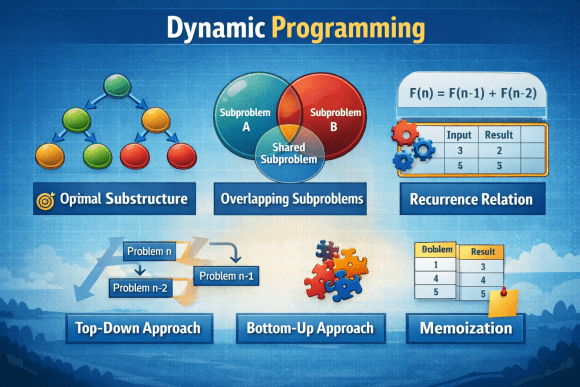
At its core, dynamic programming (DP) is a method for solving problems that exhibit two key properties: optimal substructure and overlapping subproblems. Optimal substructure means that the solution to a larger problem can be constructed efficiently from solutions to its smaller subproblems. Overlapping subproblems refer to the fact that these smaller problems recur multiple times within the larger problem, making it inefficient to solve them repeatedly without storing intermediate results. This foundational idea allows DP to avoid redundant calculations, significantly reducing computational complexity.

The process of dynamic programming involves formulating a problem into a recursive structure, often expressed through recurrence relations. Once this formulation is established, solutions are typically implemented using either top-down approaches with memoization, where solutions to subproblems are stored to prevent recomputation, or bottom-up approaches that iteratively build solutions from the smallest subproblems upward. This flexibility makes DP adaptable to a wide range of problem types and computational environments.

Another fundamental aspect of DP is the use of tables or arrays to store intermediate results, often called memoization or tabulation. These data structures serve as repositories for solutions to subproblems, enabling quick retrieval and efficient assembly of the final answer. The careful design of these tables, including the dimensions and indexing schemes, is crucial for ensuring optimal performance and correct implementation.

Overall, dynamic programming provides a structured framework for tackling complex problems by exploiting their inherent recursive properties. Its foundation rests on identifying the recursive structure, leveraging overlapping subproblems, and systematically storing intermediate results to optimize computation. This foundational understanding paves the way for developing efficient algorithms across a spectrum of computational challenges.


Key Principles and Strategies in Dynamic Programming Solutions

The effectiveness of dynamic programming hinges on several key principles and strategic approaches. First, recognizing the presence of optimal substructure in a problem is paramount. This involves analyzing whether the problem’s optimal solution can be composed of optimal solutions to its subproblems. Once established, the problem can be formulated through recurrence relations that define the solution in terms of smaller instances.

Second, choosing between a top-down or bottom-up approach is a strategic decision in DP implementation. The top-down approach, known as memoization, involves recursive function calls with caching of intermediate results. It is intuitive and often easier to implement, especially when the problem naturally lends itself to recursion. Conversely, the bottom-up approach, or tabulation, iteratively solves all subproblems starting from the smallest, filling up a table until the final solution emerges. This approach can be more efficient in terms of space and time, especially when the problem’s structure is well-understood.

Third, the design of the state space and transition functions is a core strategic element. Defining the right states—parameters that capture the essential information needed to solve subproblems—is crucial. Transition functions, which specify how to move from one state to another, must be carefully crafted to reflect the problem’s constraints and objectives. This step often involves insightful problem analysis and can significantly influence the complexity and feasibility of the solution.

Finally, optimization techniques such as space reduction, pruning, and problem-specific heuristics can enhance DP implementations. For example, in some cases, the size of the DP table can be minimized through clever state compression, or unnecessary computations can be avoided via pruning strategies. These strategies, combined with thorough testing and validation, ensure that dynamic programming solutions are both efficient and robust across different problem instances.


Practical Applications of Dynamic Programming Across Industries

Dynamic programming’s versatility makes it applicable across a wide range of industries and problem domains. In computer science, it is fundamental in designing algorithms for shortest path problems, such as Dijkstra’s and Bellman-Ford algorithms, and in solving combinatorial optimization problems like the knapsack, longest common subsequence, and matrix chain multiplication. These applications underpin many software solutions, from routing systems to data comparison tools.

In the field of operations research and supply chain management, DP is employed to optimize resource allocation, production scheduling, and inventory management. For instance, companies use DP models to determine the most cost-effective way to allocate limited resources over time, balancing supply and demand while minimizing costs. This strategic application helps organizations improve efficiency, reduce waste, and enhance decision-making processes.

The healthcare industry also benefits from dynamic programming in areas such as medical imaging, treatment planning, and genetic analysis. In radiotherapy, for example, DP algorithms optimize dose distributions to maximize tumor eradication while minimizing damage to healthy tissue. Similarly, in bioinformatics, DP techniques are used for sequence alignment and gene prediction, facilitating advances in personalized medicine and genomic research.

Financial services leverage dynamic programming for portfolio optimization, risk management, and option pricing. These applications involve complex decision-making under uncertainty, where DP helps evaluate multiple scenarios and determine strategies that maximize returns or minimize risks over time. By enabling more accurate and computationally feasible models, DP contributes significantly to financial modeling and strategic planning.


Challenges and Best Practices for Implementing Dynamic Programming

Implementing dynamic programming effectively requires careful consideration of several challenges. One common issue is the exponential growth of the state space, which can lead to large memory requirements and slow computations. To address this, practitioners often employ state space reduction techniques, such as problem-specific heuristics or state compression, to make the problem more manageable.

Another challenge is identifying the correct recurrence relations and ensuring they accurately capture the problem’s constraints and objectives. Incorrect formulation can lead to suboptimal solutions or computational inefficiencies. Thorough problem analysis, mathematical modeling, and testing are essential to develop accurate recurrence relations and transition functions.

Handling numerical stability and precision, especially in floating-point calculations, is also critical in DP applications involving probabilistic models or financial computations. Implementing safeguards, such as using appropriate data types and normalization techniques, helps maintain the integrity of results. Additionally, debugging DP algorithms can be complex due to their recursive nature, so systematic testing with small, known inputs is recommended.

Best practices for implementing dynamic programming include modular code design, clear documentation of state definitions and transition logic, and incremental development with validation at each step. Profiling and optimizing the code for time and space efficiency help ensure scalability. Finally, staying aware of problem-specific nuances and leveraging domain expertise can lead to more effective and elegant DP solutions, ultimately maximizing their benefits across various applications.

Kategorien
Uncategorized

Understanding Reinforcement Learning: Principles and Applications

Reinforcement Learning (RL) is a branch of machine learning that focuses on how agents ought to take actions in an environment to maximize cumulative rewards. Unlike supervised learning, which relies on labeled data, RL emphasizes learning through trial and error, allowing agents to develop strategies based on interactions with their surroundings. This approach has gained significant attention due to its success in solving complex decision-making problems, from game playing to autonomous control systems. Understanding the core principles and applications of RL provides insights into its potential to transform various industries and pave the way for intelligent, adaptive systems.

Introduction to Reinforcement Learning: Core Concepts and Definitions

Reinforcement Learning is centered around the interaction between an agent and its environment. The agent perceives the environment’s current state, makes a decision by choosing an action, and then receives feedback in the form of a reward or penalty. This cycle repeats, enabling the agent to learn a policy—a strategy that maps states to actions—that maximizes long-term rewards. Key concepts in RL include states, actions, rewards, policies, and value functions, all of which work together to guide decision-making processes. The goal is to develop an optimal policy that yields the highest expected cumulative reward over time.

At the heart of RL is the Markov Decision Process (MDP), a mathematical framework that models the environment as a set of states, actions, transition probabilities, and reward functions. MDPs assume the Markov property, meaning that the future state depends only on the current state and action, not on past states. This property simplifies the problem and allows algorithms to estimate the value of states and actions effectively. The value functions—state-value and action-value functions—measure the expected return starting from a given state or state-action pair, serving as guides for policy improvement.

Reinforcement learning algorithms can be broadly categorized into model-free and model-based methods. Model-free algorithms, like Q-learning and SARSA, learn optimal policies directly from experience without constructing a model of the environment. In contrast, model-based methods involve building a model of the environment’s dynamics and using it for planning. Additionally, RL techniques often incorporate exploration strategies, such as epsilon-greedy policies, to balance the trade-off between exploring new actions and exploiting known rewarding actions. These foundational principles enable RL agents to adaptively learn complex behaviors over time.

Reinforcement learning has also evolved to include deep learning techniques, leading to Deep Reinforcement Learning (Deep RL). By integrating neural networks, Deep RL can handle high-dimensional input spaces, such as raw images or sensor data, which were previously challenging for traditional RL algorithms. This synergy has opened new avenues for applications requiring perception and decision-making, making RL a versatile and powerful framework for autonomous systems and artificial intelligence.

Fundamental Principles of Reinforcement Learning Algorithms

The core principle of reinforcement learning algorithms is to iteratively improve the policy based on observed rewards and experiences. This process typically involves two main components: policy evaluation and policy improvement. In policy evaluation, the agent estimates the value functions based on the current policy, assessing how good it is to be in particular states or to take specific actions. During policy improvement, the agent updates its policy to favor actions that lead to higher value estimates, gradually converging toward optimal behavior. This iterative process underpins many RL algorithms, such as policy iteration and value iteration.

Temporal Difference (TD) learning is a fundamental principle in RL, combining ideas from Monte Carlo methods and dynamic programming. TD learning updates value estimates based on the difference between predicted and actual rewards received after taking an action, known as the TD error. This approach allows for online learning and continuous updates, making it well-suited for environments where data arrives sequentially. Q-learning, a popular model-free algorithm, uses TD learning to estimate the optimal action-value function, enabling the agent to learn the best actions independently of a fixed policy.

Another key principle in RL is the exploration-exploitation trade-off. To learn effectively, an agent must explore new actions to discover potentially better rewards, while exploiting known rewarding actions to maximize immediate gains. Strategies like epsilon-greedy, softmax, and upper confidence bounds help balance this trade-off. Proper management of exploration ensures that the agent does not prematurely converge to suboptimal policies and continues to seek out improved strategies over time.

Deep reinforcement learning extends these principles by employing neural networks to approximate value functions or policies, enabling agents to operate in complex, high-dimensional environments. Techniques such as Deep Q-Networks (DQN) combine Q-learning with deep neural networks, leveraging function approximation to handle raw sensory inputs. These algorithms rely on experience replay and target networks to stabilize training, exemplifying how foundational RL principles are adapted to modern, scalable architectures. This integration of deep learning with RL continues to drive innovation and expand the scope of problems that can be tackled.

Key Applications of Reinforcement Learning Across Industries

Reinforcement learning has made a significant impact across a diverse range of industries, demonstrating its versatility and potential for real-world problems. In the gaming industry, RL has achieved remarkable success, most notably with DeepMind’s AlphaGo, which defeated world champions in the game of Go. Such achievements showcase RL’s ability to master complex strategic environments through self-play and continuous learning. This success has spurred further research into RL applications in other domains requiring strategic planning and decision-making.

In the autonomous vehicle industry, RL is employed to optimize driving policies for navigation, obstacle avoidance, and adaptive control systems. By learning from simulated and real-world driving data, RL algorithms enable vehicles to adapt to dynamic environments, improve safety, and enhance efficiency. Similarly, in robotics, RL facilitates the development of control policies for tasks such as manipulation, locomotion, and multi-agent coordination, allowing robots to learn complex behaviors through interaction with their environment.

In finance and healthcare, RL is increasingly used for decision support and optimization. In finance, algorithms leverage RL for portfolio management, trading strategies, and risk assessment, adapting to market fluctuations in real-time. In healthcare, RL assists in personalized treatment planning, drug discovery, and resource allocation, aiming to improve patient outcomes while minimizing costs. These applications highlight RL’s capacity to handle complex, high-stakes decision-making scenarios where adaptability and learning from experience are crucial.

Beyond these sectors, reinforcement learning is also making strides in supply chain management, energy optimization, and personalized recommendations. For example, RL algorithms optimize energy consumption in smart grids by dynamically adjusting resource allocation based on demand patterns. In e-commerce, RL powers recommendation systems that adapt to user preferences over time, enhancing engagement and satisfaction. As industries continue to recognize the value of adaptive, data-driven decision-making, RL’s role is expected to expand further, transforming traditional processes and creating smarter, more autonomous systems.

Challenges and Future Directions in Reinforcement Learning Research

Despite its successes, reinforcement learning faces several challenges that limit its widespread deployment and effectiveness. One major obstacle is sample inefficiency, where RL algorithms often require vast amounts of data and interactions with the environment to learn effective policies. This makes real-world applications, especially in safety-critical domains like healthcare and autonomous driving, difficult and costly. Researchers are exploring techniques such as transfer learning, imitation learning, and model-based RL to improve data efficiency and reduce training time.

Another challenge is the stability and convergence of RL algorithms, particularly when combined with deep neural networks. Training deep RL agents can be unstable, leading to issues like catastrophic forgetting or divergence. Techniques like experience replay, target networks, and regularization have been developed to mitigate these problems, but ongoing research aims to create more robust and scalable algorithms. Additionally, addressing issues related to exploration, such as overly conservative or reckless behaviors, remains an active area of investigation.

Looking ahead, the future of reinforcement learning involves integrating it more seamlessly with other AI paradigms, such as supervised learning, unsupervised learning, and symbolic reasoning. This hybrid approach could lead to more generalizable and explainable AI systems capable of reasoning, planning, and learning in complex environments. Advances in multi-agent RL, where multiple agents learn and interact, also hold promise for applications in distributed systems, economics, and social simulations. As computational power continues to grow and algorithms become more sophisticated, RL is poised to play an increasingly vital role in building autonomous, intelligent systems that can adapt to a wide range of challenges.

Furthermore, ethical considerations and safety are becoming central to RL research, especially as autonomous systems become more integrated into daily life. Ensuring that RL agents behave reliably, transparently, and ethically is critical for gaining public trust and regulatory approval. Future directions include developing formal safety guarantees, interpretability methods, and frameworks for human-in-the-loop reinforcement learning. These efforts aim to ensure that RL-driven technologies are not only powerful but also aligned with societal values and safety standards, fostering responsible innovation in the field.

Reinforcement Learning continues to evolve as a vital area of artificial intelligence, underpinning advancements across numerous sectors. Its core principles—learning through interaction, balancing exploration with exploitation, and optimizing long-term rewards—enable the development of adaptive and intelligent systems. While challenges remain, ongoing research and technological innovations promise to expand RL’s capabilities and applications, shaping a future where autonomous agents can efficiently learn, adapt, and collaborate in complex environments. As the field progresses, understanding these fundamental concepts and emerging trends will be essential for leveraging RL’s full potential.

Kategorien
Uncategorized

An Overview of Oracle Cloud Infrastructure: Features and Benefits

In the rapidly evolving landscape of cloud computing, organizations are increasingly seeking robust, scalable, and secure cloud solutions to support their digital transformation initiatives. Oracle Cloud Infrastructure (OCI) stands out as a leading platform designed to meet the complex needs of modern businesses. With a comprehensive suite of cloud services, OCI offers a blend of performance, security, and cost-efficiency that appeals to enterprises across various industries. This article provides an overview of OCI, highlighting its core offerings, key features, security measures, performance benefits, pricing strategies, and future innovations.

Introduction to Oracle Cloud Infrastructure and Its Core Offerings

Oracle Cloud Infrastructure (OCI) is Oracle Corporation’s enterprise-grade cloud platform, built to provide high-performance computing, storage, and networking capabilities. It is designed to support mission-critical workloads, including databases, analytics, and enterprise applications, with a focus on reliability and security. OCI’s core offerings encompass compute instances, block storage, object storage, networking, and database services, all integrated into a unified environment that facilitates seamless deployment and management. Its architecture emphasizes low latency and high throughput, making it suitable for demanding enterprise applications.

One of OCI’s distinguishing features is its emphasis on hybrid cloud and interoperability. It supports hybrid deployments, allowing organizations to extend their on-premises infrastructure to the cloud or operate in a multi-cloud environment. Additionally, OCI offers specialized services such as Oracle Autonomous Database, which leverages machine learning to automate database tuning, patching, and security. The platform also provides tools for analytics, AI, and developer services, ensuring that organizations have access to a comprehensive ecosystem for building, deploying, and managing cloud-native applications.

OCI’s global presence is another core aspect, with data centers strategically located across North America, Europe, Asia, and other regions. This widespread infrastructure enables businesses to deploy workloads closer to their users, ensuring compliance with regional data regulations and reducing latency. The platform’s compatibility with open standards and support for popular developer frameworks further enhance its flexibility, allowing organizations to modernize their IT environment efficiently.

Overall, Oracle Cloud Infrastructure aims to deliver a secure, high-performance, and flexible cloud environment tailored to the needs of large-scale enterprises. Its core offerings are designed to support diverse workloads, from traditional enterprise applications to innovative cloud-native solutions, making it a versatile choice for organizations seeking a comprehensive cloud platform.

Key Features of Oracle Cloud Infrastructure for Modern Businesses

OCI offers a rich set of features designed to meet the demands of modern enterprises. One of its standout capabilities is its high-performance compute environment, which includes bare metal servers and virtual machine instances optimized for intensive workloads such as data analytics, machine learning, and enterprise applications. These compute options are complemented by flexible scaling options, enabling businesses to adjust resources dynamically based on workload requirements, thereby optimizing performance and cost.

Networking features in OCI are equally robust, providing advanced options such as Virtual Cloud Networks (VCNs), load balancers, and dedicated connectivity solutions like FastConnect. These tools facilitate secure and reliable network architectures, supporting hybrid cloud deployments and ensuring seamless integration with on-premises data centers. OCI’s networking infrastructure is designed for high throughput and low latency, critical for applications that demand real-time data processing.

Security is a cornerstone of OCI, with features such as identity and access management (IAM), encryption at rest and in transit, and comprehensive monitoring and logging tools. The platform also offers automated security patches and updates, reducing the risk of vulnerabilities. Additionally, OCI supports compliance with numerous industry standards and regulations, making it suitable for sensitive workloads in finance, healthcare, and government sectors.

Development and deployment are streamlined through OCI’s support for container orchestration services like Kubernetes, as well as DevOps tools for continuous integration and continuous delivery (CI/CD). These features enable organizations to accelerate application development cycles and adopt modern development practices. Overall, OCI’s extensive feature set provides modern businesses with the tools needed to innovate, scale, and operate securely in the cloud.

Security and Compliance Measures in Oracle Cloud Infrastructure

Security is a fundamental aspect of OCI, with a multi-layered approach designed to protect data, applications, and infrastructure. The platform employs advanced encryption techniques for data at rest and in transit, ensuring that sensitive information remains protected from unauthorized access. Identity and Access Management (IAM) services enable granular control over user permissions, minimizing the risk of insider threats and accidental data exposure.

OCI also provides comprehensive monitoring and logging capabilities through services like Oracle Cloud Guard and Audit, which help organizations detect and respond to security threats promptly. Automated security updates and patch management further enhance the platform’s resilience by reducing vulnerabilities. Additionally, OCI’s architecture is designed to isolate workloads, preventing lateral movement of threats within the cloud environment.

Oracle Cloud Infrastructure maintains compliance with numerous industry standards and regulatory frameworks, including GDPR, HIPAA, SOC 2, and ISO certifications. This commitment to compliance simplifies the process for organizations to meet legal and regulatory requirements across different regions. The platform also offers tools for vulnerability assessment and security posture management, empowering businesses to proactively identify and mitigate risks.

Furthermore, OCI emphasizes physical security across its data centers, with features such as biometric access controls, video surveillance, and 24/7 security personnel. The combination of technical and physical security measures ensures a robust defense against a wide range of threats. Overall, OCI’s security and compliance framework provides organizations with confidence in their cloud operations, enabling them to focus on innovation without compromising security.

Performance and Scalability Benefits of Using OCI

One of OCI’s key advantages is its high-performance infrastructure, optimized for demanding enterprise workloads. The platform’s bare metal servers and custom-designed networking hardware deliver low latency and high throughput, essential for applications such as real-time analytics, machine learning, and large-scale databases. These capabilities enable organizations to achieve faster insights and improved operational efficiency.

Scalability is a core feature of OCI, allowing businesses to easily adjust their resources in response to changing demands. Whether scaling vertically by adding more compute power or horizontally by deploying additional instances, OCI provides flexible options to accommodate growth. Its autoscaling features automatically adjust resources based on predefined policies, ensuring optimal performance while controlling costs. This elasticity supports both predictable and unpredictable workload fluctuations seamlessly.

OCI’s global infrastructure also enhances scalability by enabling regional deployment of workloads closer to end-users. This reduces latency and improves user experience, especially for applications with a worldwide reach. The platform’s support for containerization and orchestration with Kubernetes further simplifies application scaling and management, making it easier for developers to deploy updates and roll out new features rapidly.

Performance monitoring and optimization tools integrated into OCI allow organizations to track resource utilization, identify bottlenecks, and fine-tune their deployments for maximum efficiency. Overall, OCI’s performance and scalability features empower businesses to innovate confidently, knowing their cloud environment can grow alongside their needs without compromising speed or reliability.

Cost Management and Pricing Strategies in Oracle Cloud Services

Cost management is a critical concern for organizations leveraging cloud infrastructure, and OCI offers several strategies to optimize expenditure. Oracle provides transparent and competitive pricing models, including pay-as-you-go and reserved instance options, allowing businesses to choose the most cost-effective approach based on their usage patterns. The platform also offers flexible billing cycles and detailed cost tracking, helping organizations monitor and control their cloud expenses effectively.

To further enhance cost efficiency, OCI includes tools such as the Cost Analysis dashboard and Budget service, which provide insights into spending trends and enable proactive budget management. These tools help organizations identify unused or underutilized resources and optimize their resource allocation accordingly. Additionally, OCI supports resource tagging, allowing for detailed cost attribution and accountability across teams and projects.

Oracle’s commitment to cost predictability is complemented by its free tier offerings and trial periods, enabling businesses to experiment with services without initial investment. The platform’s auto-scaling and elastic capabilities also contribute to cost savings by adjusting resource consumption in real-time based on workload demands. This dynamic provisioning ensures organizations pay only for what they use, avoiding over-provisioning and unnecessary expenses.

Looking ahead, OCI continues to innovate in cost management, introducing features like spot instances and cost optimization recommendations powered by AI. These developments aim to make cloud spending more predictable and efficient, empowering organizations to maximize their return on investment while maintaining high performance and security standards.

Future Developments and Innovations in Oracle Cloud Infrastructure

Oracle Cloud Infrastructure is poised for significant growth and innovation, with ongoing investments in emerging technologies and expanded service offerings. One area of focus is artificial intelligence and machine learning, where OCI is developing advanced tools and frameworks to integrate AI capabilities directly into cloud applications. This includes enhancements to Oracle Autonomous Database and new AI-driven analytics services, enabling smarter decision-making and automation.

Another key area of development is hybrid and multi-cloud integration. OCI is expanding its support for hybrid cloud architectures, facilitating seamless interoperability between on-premises data centers and the cloud. This approach allows organizations to optimize their existing infrastructure investments while leveraging the cloud’s agility. Additionally, OCI’s multi-cloud strategies aim to provide greater flexibility and avoid vendor lock-in, empowering enterprises to choose the best services across different cloud providers.

Security and compliance remain central to OCI’s future roadmap, with innovations aimed at further automating security operations and enhancing data privacy features. Oracle is investing in security automation tools that leverage AI to detect and respond to threats in real-time, reducing manual intervention and response times. Furthermore, OCI is aligning with upcoming regulatory standards to ensure continued compliance and trustworthiness in global markets.

Finally, OCI is exploring advancements in edge computing, IoT, and 5G connectivity, aiming to bring cloud capabilities closer to the data sources and end-users. These innovations will enable real-time processing at the edge, supporting use cases such as autonomous vehicles, smart cities, and industrial automation. As Oracle continues to evolve its cloud platform, organizations can expect a more integrated, intelligent, and secure environment that supports their digital transformation journeys well into the future.

Oracle Cloud Infrastructure offers a comprehensive, secure, and high-performance cloud platform tailored to the needs of modern enterprises. With its wide array of features, robust security measures, and scalable infrastructure, OCI provides organizations with the tools necessary to innovate and grow confidently. As Oracle invests in future technologies and expands its service ecosystem, OCI is well-positioned to remain a vital component of enterprise cloud

Kategorien
Uncategorized

Cloud Data Warehouse Security: a practical guide

Cloud data warehouses concentrate an organization’s most valuable information in one place. That makes them a prime target—and also a great opportunity to build consistency: one set of controls, one set of logs, one way to share data safely. This article lays out a vendor-neutral blueprint that teams can apply across platforms.

Start with a clear threat model

List what you’re defending and from whom. For most teams, the credible threats are:

  • Account compromise (phished credentials, leaked keys, over-privileged service roles).
  • Misconfiguration (public endpoints left open, permissive sharing, weak network boundaries).
  • Data handling mistakes (over-broad access, copies to unsafe tiers, test data with PII).
  • Supply chain and SaaS integrations (BI tools, reverse ETL, notebooks, partner links).
  • Ransomware/exfiltration via insiders or compromised pipelines.

Write these down with potential blast radius and mitigations. Revisit quarterly—threats evolve as your platform does.

Shared responsibility, made explicit

Cloud providers secure the infrastructure; you secure your identities, configuration, and data. Put that in your runbooks:

  • Who owns identity, keys, networks, warehouse policies, and monitoring?
  • What’s automated (policy-as-code) vs. manual?
  • What evidence do you store for audits (and where)?

Classify data before you protect it

Security follows classification. Define a small, usable set of labels—e.g., Public, Internal, Confidential, Restricted (PII/PHI)—and make the label part of the metadata from the moment data lands. Enforce different guardrails by class. Example:

  • Restricted: masked by default, separate projects/schemas, tight egress, strict sharing rules, shorter retention.
  • Internal: readable to relevant teams, masked in lower environments, monitored egress.
  • Public: can be shared but still versioned and watermarked.

Automate classification hints from schemas, lineage, and DLP scans, but keep a human-in-the-loop for sensitive tables.

Identity and access: least privilege by default

Treat identity as the perimeter.

  • SSO everywhere. Use your IdP for users and admins; disable local accounts. Sync groups with SCIM and manage access through groups, not individuals.
  • Service identities for pipelines and apps. Prefer short-lived, federated credentials over long-lived keys. Rotate automatically.
  • RBAC + ABAC. Start with roles, then add attributes (department, dataset sensitivity, region) for finer control. Keep policies readable and versioned.
  • Row/column-level security. Make the warehouse enforce data-minimization:
    • Default-deny columns containing PII.
    • Policies that filter rows by the caller’s attributes (e.g., region = user.region).
  • Access reviews. Quarterly, automated where possible. Remove dormant accounts and stale grants.

Network design: assume zero trust

Don’t rely on “we’re inside the VPC” for safety.

  • Private endpoints to the warehouse; disable public access or restrict by approved ranges.
  • Ingress via proxies or VPNs with device posture checks when interactive access is needed.
  • Egress controls from compute (ETL, notebooks) and from the warehouse to prevent blind exfiltration. Maintain allow-lists for external locations.
  • Segmentation by environment (prod/stage/dev) and, for high sensitivity, by data domain.

Encryption and key management

Encryption is table stakes; key management is where design matters.

  • At rest/in transit: turn on everywhere, verify with configuration baselines.
  • KMS strategy: unique keys per environment and (for Restricted data) per domain. Use envelope encryption, rotation, and separation of duties: platform team manages keys, data owners manage policies.
  • BYOK/HYOK where policy or regulation requires it—but weigh operational complexity.
  • Tokenization & FPE (format-preserving encryption) for fields that must keep shape (e.g., masked card numbers).

Data protection in practice: masking, tokenization, minimization

Protect sensitive data by default, not by convention.

  • Dynamic masking for analysts and non-PII roles; reveal on a need-to-know exception.
  • De-identify lower environments: synthetic or masked datasets in dev/test; prevent raw PII copies.
  • Selective materialization: share only curated, minimal views; avoid full-table exports.
  • Watermarking exports and governed sharing features to trace leaks.

Governance that helps, not hinders

Good governance speeds teams up by setting clear lanes.

  • Data contracts: what’s in a table, who owns it, sensitivity, SLOs, and change policy.
  • Lineage + catalog integrated with classification so you can trace sensitive columns end-to-end.
  • Retention & deletion mapped to policy (legal hold, privacy requirements). Automate purge jobs and prove they ran.
  • Privacy by design: collect less, aggregate early, and prefer pseudonymization over raw identifiers where possible.

Observability, logging, and detection

You can’t defend what you can’t see.

  • Centralize logs: authentication, query history, policy changes, data load/export events, and admin actions—streamed to a security data lake.
  • High-signal alerts: impossible travel, role escalation, queries that touch Restricted data outside business hours, spikes in export volume, sudden policy relaxations.
  • Anomaly detection tuned to your access patterns; start simple (thresholds) before fancy models.
  • Tamper-evident storage for logs and backups (WORM/immutability) to withstand ransomware.

Backups, DR, and resilience

Treat recovery as a security control.

  • Immutable, versioned backups with separate credentials and blast radius.
  • Point-in-time recovery tested regularly; keep runbooks for “oops we dropped a schema,” “region outage,” and “ransomware in staging.”
  • Cross-region replication for critical datasets, with clear RPO/RTO targets.
  • Quarterly restore drills that prove you can meet those targets.

Secure integrations and sharing

BI tools, notebooks, reverse ETL, and partners are where data escapes.

  • Service accounts per integration; least privilege, scoped tokens, short lifetimes.
  • Network path: private connectivity or brokered access; avoid open internet.
  • Row/column policies persist through views shared to downstream tools.
  • Partner sharing: prefer platform-native sharing over file drops; watermark and monitor usage.

DevSecOps for data platforms

Ship security with your code and configs.

  • IaC / policy-as-code for warehouses, networks, roles, and policies. Peer review and CI checks.
  • Pre-merge scanners for dangerous grants, public endpoints, and missing encryption.
  • Secrets management via a vault; no credentials in notebooks or job definitions.
  • Golden modules (reusable Terraform/Cloud templates) that bake in guardrails.
  • Change management: small, reversible changes; audit every policy diff.

Common anti-patterns (and what to do instead)

  • One giant “analyst” role with SELECT on everything. → Break into domain roles + ABAC conditions; default-deny Restricted columns.
  • Public endpoints “just for testing.” → Use preview environments behind private access; kill public access at the org policy layer.
  • PII in dev because “the bug only reproduces with real data.” → Ship a de-identification pipeline and synthetic test fixtures.
  • Long-lived service keys in Git. → Workload identity federation and short-lived tokens.
  • Backups writable by the same role that writes production. → Separate principals, immutable storage, periodic restore tests.

A 90-day hardening roadmap

Days 0–30: Baseline & quick wins
Turn off public endpoints where possible, enforce SSO/SCIM, centralize logs, inventory high-risk tables, and enable default masking for those columns. Create environment-specific KMS keys and rotate stale credentials.

Days 31–60: Least privilege & data-aware controls
Refactor roles to domain-scoped groups; add ABAC for region/department. Implement row/column policies on Restricted datasets. Lock down dev/test with de-identified data pipelines and egress allow-lists.

Days 61–90: Resilience & automation
Set up immutable backups, PITR, and cross-region replication for crown jewels. Write incident runbooks and run a tabletop exercise. Move warehouse, IAM, and network configs to IaC with CI policy checks. Schedule quarterly access reviews and restore drills.

Measuring success

Pick a handful of metrics that reflect real risk reduction:

  • % of Restricted columns covered by masking/tokenization.
  • Median time to revoke access after role change.
  • of long-lived keys remaining (drive to zero).
  • % of data exports using governed sharing vs. files.
  • Mean time to detect anomalous access to Restricted data.
  • Restore success rate and time in quarterly drills.

Bottom line: Strong cloud data warehouse security isn’t one silver bullet; it’s a set of simple, reinforced habits. Classify data, make identity the perimeter, deny by default, keep secrets and keys tight, keep networks private, log everything that matters, and practice recovery. Do those consistently, and your platform stays both useful and safe—even as it grows.

Kategorien
Cloud Data Warehouses

Azure Synapse Analytics: Microsoft’s Cloud Data Warehouse

Introduction

As organizations increasingly rely on data to drive decision-making, the demand for cloud-based analytics platforms has surged. Among the leading solutions is Azure Synapse Analytics, Microsoft’s flagship cloud data warehouse. Formerly known as Azure SQL Data Warehouse, Synapse has evolved into a comprehensive analytics service that unifies enterprise data warehousing, big data integration, and real-time analytics into a single platform.


What is Azure Synapse Analytics?

Azure Synapse Analytics is a fully managed cloud data warehouse designed for scalable, high-performance analytical workloads. It combines the familiarity of SQL-based querying with advanced capabilities for big data, machine learning, and business intelligence. Synapse enables organizations to ingest, prepare, manage, and serve data for immediate business intelligence and predictive analytics.

Unlike traditional warehouses that are rigid and costly to scale, Synapse leverages the elasticity of the cloud, allowing organizations to scale compute and storage independently and on-demand.


Key Features of Azure Synapse

1. Elastic Scalability

  • Compute and storage resources are decoupled, enabling independent scaling.
  • Organizations can provision high performance for peak workloads and scale down during quiet periods to optimize costs.

2. Integrated Analytics

  • Synapse seamlessly integrates with Azure Data Lake Storage, allowing enterprises to combine structured and semi-structured data in analytics workflows.
  • It supports both serverless on-demand queries and dedicated SQL pools, giving flexibility in balancing cost and performance.

3. Tight Integration with the Microsoft Ecosystem

  • Power BI for visualization and business dashboards.
  • Azure Machine Learning for predictive modeling and AI.
  • Azure Data Factory for orchestrating ETL pipelines.
  • Microsoft Purview for data governance and cataloging.

This deep integration makes Synapse a natural fit for enterprises already invested in Microsoft Azure.

4. Performance at Scale

  • Uses massively parallel processing (MPP) to handle large datasets efficiently.
  • Employs columnar storage and data distribution strategies to accelerate query execution.

5. Security and Compliance

  • Features encryption at rest and in transit, as well as advanced identity and access management.
  • Complies with major regulatory standards including GDPR, HIPAA, SOC, and ISO certifications.

6. Hybrid and Multi-Source Data Support

  • Supports querying external data directly in Azure Data Lake or from operational databases.
  • Enables organizations to blend cloud-native and on-premises data sources in a unified platform.

Common Use Cases

  1. Business Intelligence (BI):
    Organizations use Synapse to centralize data and provide real-time dashboards via Power BI.
  2. Data Lakehouse Architecture:
    By combining with Azure Data Lake Storage, Synapse serves as the query and analytics layer of a modern “lakehouse” solution.
  3. Advanced Analytics and AI:
    Data scientists leverage Synapse with Azure ML and notebooks to develop predictive models directly from warehouse data.
  4. Operational Reporting:
    Enterprises automate reporting pipelines and reduce latency in operational insights.

Strengths of Azure Synapse Analytics

  • Deep integration with the Microsoft Azure ecosystem.
  • Flexible compute models (serverless and dedicated).
  • Familiar SQL interface for existing database teams.
  • Strong governance and compliance features.
  • Scales efficiently to petabytes of data.

Challenges and Considerations

  • Learning curve: Organizations must adapt to Synapse’s hybrid query model (serverless vs. dedicated).
  • Cost management: While flexible, costs can rise without governance, especially with serverless queries over massive datasets.
  • Competition: Rivals like Snowflake and Google BigQuery offer strong multi-cloud and simplified pricing models.

Conclusion

Azure Synapse Analytics stands out as a powerful, enterprise-ready cloud data warehouse that bridges traditional data warehousing with the agility of big data and AI. For organizations already committed to the Microsoft ecosystem, Synapse provides unmatched integration, scalability, and security.

As data-driven decision-making becomes a competitive necessity, Synapse empowers enterprises to harness the full potential of their data—from historical reporting to advanced AI-driven insights.

Architectur of Azure Synapse Analytics
Kategorien
Cloud Data Warehouses

Snowflake Cloud Data Warehouse: Redefining Modern Data Analytics

Introduction

In today’s data-driven economy, organizations require platforms that are not only scalable and high-performing but also simple to use and cost-efficient. Among the leading solutions, Snowflake has emerged as one of the most transformative cloud-native data warehouses. Launched in 2014, Snowflake quickly gained traction due to its unique architecture, multi-cloud availability, and user-friendly approach to handling structured and semi-structured data.

Snowflake has fundamentally redefined what a data warehouse can be—evolving from a traditional reporting system into a data platform that powers analytics, machine learning, and data sharing at scale.


Key Architectural Innovations

1. Separation of Storage and Compute

At the heart of Snowflake’s innovation is the decoupling of storage and compute layers:

  • Storage Layer: All data is stored in low-cost cloud object storage (e.g., Amazon S3, Google Cloud Storage, Azure Blob). Data is compressed, encrypted, and organized for fast retrieval.
  • Compute Layer: Queries run on independent clusters called virtual warehouses. Multiple clusters can access the same data simultaneously without conflicts or duplication.
  • Benefit: Organizations can scale compute resources up or down independently of storage, optimizing performance and cost.

2. Multi-Cluster, Shared Data Architecture

Snowflake’s design enables multiple compute clusters to access the same data concurrently. This allows:

  • Isolated performance for different workloads (e.g., BI, data science, ETL).
  • Support for high-concurrency environments without query slowdowns.
  • Simplified collaboration across departments or user groups.

3. Native Support for Semi-Structured Data

Unlike legacy warehouses that struggle with non-relational formats, Snowflake natively supports:

  • JSON
  • Avro
  • Parquet
  • ORC
  • XML

Users can load, store, and query semi-structured data using SQL with schema-on-read flexibility. This makes it ideal for handling logs, IoT data, clickstreams, and API responses.


4. Multi-Cloud and Global Availability

Snowflake runs on AWS, Azure, and Google Cloud, offering organizations the freedom to choose their preferred cloud or even operate in a multi-cloud environment. With global availability, enterprises can deploy Snowflake close to their users and comply with data residency requirements.


5. Serverless Features and Automation

Snowflake minimizes operational overhead by offering:

  • Automatic scaling and clustering
  • Query optimization without manual tuning
  • Zero-copy cloning (create instant copies of datasets for testing)
  • Time Travel (query past versions of data)
  • Fail-safe recovery for disaster protection

Security and Compliance

Snowflake provides enterprise-grade security with:

  • Always-on encryption (in transit and at rest).
  • Fine-grained access control through role-based access control (RBAC).
  • Compliance certifications (GDPR, HIPAA, SOC 2, FedRAMP, etc.).
  • Support for private connectivity options like AWS PrivateLink and Azure Private Link.

Pricing Model

Snowflake uses a pay-as-you-go model:

  • Storage costs are billed separately from compute.
  • Compute usage is measured per-second for each virtual warehouse.
  • This enables organizations to pay only for what they use, with the ability to pause compute when not in use.

Key Use Cases

  1. Business Intelligence (BI) and Analytics
    • Fast SQL queries for dashboards and reporting.
    • Seamless integration with Tableau, Power BI, Looker, and other BI tools.
  2. Data Science and Machine Learning
    • Direct integration with Python, R, and ML platforms.
    • Data scientists can train models on Snowflake-managed datasets.
  3. Data Sharing and Collaboration
    • Snowflake’s Secure Data Sharing allows organizations to share live datasets with partners, vendors, or customers without duplication.
  4. Data Lake Integration
    • Query semi-structured data directly without pre-processing.
    • Combine structured and unstructured datasets for advanced analytics.

Strengths and Considerations

Strengths

  • True cloud-native design (not retrofitted from legacy systems).
  • Independent scaling of storage and compute.
  • Multi-cloud flexibility.
  • Easy to use—minimal DBA involvement required.
  • Advanced features: time travel, cloning, and secure sharing.

Considerations

  • Costs can increase with uncontrolled compute usage.
  • Proprietary platform—risk of vendor lock-in.
  • Performance may vary for highly unstructured data workloads compared to specialized data lakes.

Conclusion

Snowflake has revolutionized the way enterprises approach data warehousing. By combining scalability, simplicity, and powerful cloud-native features, it empowers organizations to leverage data as a strategic asset. Its support for structured, semi-structured, and shared data workflows makes it more than just a data warehouse—it is a comprehensive data platform.

For businesses seeking to modernize their analytics infrastructure, reduce operational overhead, and embrace multi-cloud flexibility, Snowflake remains one of the strongest choices in the market.

Kategorien
Uncategorized

Securing RESTful APIs in Java: Best Practices and Strategies

Introduction

RESTful APIs have become the backbone of modern web applications, enabling seamless communication between clients and servers. With their wide adoption in enterprise systems, microservices, and mobile backends, security has become a critical concern. Poorly secured APIs can expose sensitive data, invite unauthorized access, and leave systems vulnerable to attacks.

In the Java ecosystem, frameworks like Spring Boot, Jakarta EE (formerly Java EE), and Micronaut provide robust tools for building REST APIs—but developers must still implement the right security measures. This article explores key concepts, best practices, and strategies for securing RESTful APIs in Java.


Core Security Principles for REST APIs

Before diving into frameworks and implementations, it’s essential to understand the fundamental security principles:

  1. Confidentiality: Protect sensitive data from unauthorized access (encryption, HTTPS).
  2. Integrity: Ensure data is not tampered with during transmission (signatures, hashing).
  3. Authentication: Verify the identity of the client or user.
  4. Authorization: Control what authenticated users are allowed to do.
  5. Non-Repudiation: Ensure actions cannot be denied later (logging, audit trails).

Common Threats to REST APIs

Java-based REST services face the same attack vectors as any other platform:

  • Man-in-the-Middle (MITM): Interception of unencrypted traffic.
  • SQL Injection / NoSQL Injection: Exploiting weak query handling.
  • Cross-Site Request Forgery (CSRF): Trick users into performing unwanted actions.
  • Broken Authentication / Session Hijacking: Exploiting weak credential storage or token handling.
  • Denial of Service (DoS): Overloading endpoints with excessive requests.

Understanding these risks is the first step to mitigating them.


Best Practices for Securing Java REST APIs

1. Use HTTPS Everywhere

  • Configure SSL/TLS in your Java application server (Tomcat, Jetty, WildFly, or embedded Spring Boot).
  • Redirect all HTTP traffic to HTTPS.
# Spring Boot application.properties
server.ssl.key-store=classpath:keystore.p12
server.ssl.key-store-password=changeit
server.ssl.key-store-type=PKCS12
server.port=8443

2. Authentication with Tokens (JWT / OAuth2)

Instead of basic authentication or session cookies, use stateless token-based authentication.

  • JWT (JSON Web Tokens): Encodes user identity and claims. Widely used in microservices.
  • OAuth2/OpenID Connect: Industry-standard for delegated authorization (used by Google, Facebook, GitHub APIs).

Example with Spring Security + JWT:

public class JwtUtil {
    private String secretKey = "mySecretKey";

    public String generateToken(String username) {
        return Jwts.builder()
                .setSubject(username)
                .setExpiration(new Date(System.currentTimeMillis() + 86400000))
                .signWith(SignatureAlgorithm.HS512, secretKey)
                .compact();
    }

    public String extractUsername(String token) {
        return Jwts.parser()
                .setSigningKey(secretKey)
                .parseClaimsJws(token)
                .getBody()
                .getSubject();
    }
}

3. Authorization with Role-Based Access Control (RBAC)

Ensure users can access only what they are allowed to.

@RestController
@RequestMapping("/admin")
public class AdminController {
    
    @GetMapping("/dashboard")
    @PreAuthorize("hasRole('ADMIN')")
    public String getDashboard() {
        return "Admin Dashboard";
    }
}

Spring Security integrates with annotations like @PreAuthorize and @Secured to enforce access control.


4. Input Validation and Sanitization

  • Use Java libraries like Hibernate Validator (javax.validation.constraints).
  • Prevent SQL injection by using JPA/Hibernate parameter binding instead of string concatenation.
@Size(max = 100)
@NotBlank
private String username;

5. Secure Data at Rest and in Transit

  • Use TLS encryption for transit.
  • Encrypt sensitive data at rest with JCE (Java Cryptography Extension) or database encryption.

6. Protect Against CSRF (Cross-Site Request Forgery)

  • For stateful sessions, use CSRF tokens (Spring Security enables this by default).
  • For stateless REST APIs, enforce SameSite=strict cookies and tokens in headers.

7. Rate Limiting and Throttling

Prevent DoS and brute-force attacks by limiting request rates.

Libraries:

  • Bucket4j (Java rate-limiting library).
  • API Gateways like Kong, AWS API Gateway, or Spring Cloud Gateway.

8. Logging, Monitoring, and Auditing

  • Use SLF4J/Logback for structured logging.
  • Integrate with monitoring tools like ELK Stack or Prometheus/Grafana.
  • Log authentication failures, suspicious activity, and access to sensitive endpoints.

Example: End-to-End Secure REST API in Spring Boot

  1. Use HTTPS with TLS certificates.
  2. Authenticate users with OAuth2 or JWT.
  3. Authorize endpoints with Spring Security annotations.
  4. Validate input with Hibernate Validator.
  5. Protect against CSRF (if stateful).
  6. Apply rate limiting.
  7. Monitor logs with centralized logging tools.

Conclusion

Securing RESTful APIs in Java is not a one-time task—it’s an ongoing process. By combining encryption, token-based authentication, RBAC, validation, and monitoring, developers can significantly reduce attack surfaces. Frameworks like Spring Boot Security make implementation easier, but it’s essential to understand the principles behind them.

As APIs continue to power digital transformation, robust API security will remain one of the most critical responsibilities for Java developers and architects.

Kategorien
Uncategorized

Amazon Redshift: Scalable Cloud Data Warehousing on AWS

Introduction

Amazon Redshift is Amazon Web Services’ (AWS) fully managed cloud data warehouse solution. Since its launch in 2012, Redshift has become one of the most widely adopted platforms for analytical workloads in the cloud. It provides enterprises with a powerful, scalable, and fully managed environment to process massive amounts of data—from gigabytes to petabytes—quickly and efficiently.

Architecture and Fundamentals

Redshift is built on a modified version of PostgreSQL, optimized specifically for analytical queries. Its architecture leverages:

  • Massively Parallel Processing (MPP): Queries are executed in parallel across multiple compute nodes, significantly improving performance.
  • Columnar Storage: Data is stored in a column-oriented format, enabling efficient compression and high-speed analytics on large datasets.
  • Redshift Spectrum: Users can query data directly from Amazon S3 without loading it into the warehouse, bridging the gap between traditional data warehousing and data lakes.

Key Features

1. Scalability and Performance

Redshift allows organizations to start small and scale up to petabytes of data. With Elastic Resize, clusters can be adjusted as needed, while Concurrency Scaling automatically adds temporary capacity during high-demand periods to maintain performance.

2. Seamless AWS Ecosystem Integration

Redshift integrates tightly with a broad range of AWS services, including:

  • Amazon S3 for external storage
  • AWS Glue for ETL and metadata cataloging
  • Amazon Kinesis for real-time streaming data
  • AWS Lambda for serverless triggers
  • Amazon QuickSight for visualization and BI

This deep integration makes Redshift a central hub for modern cloud-based analytics pipelines.

3. Security and Compliance

Redshift includes enterprise-grade security capabilities such as:

  • VPC Isolation for secure networking
  • Encryption at rest and in transit with AWS KMS
  • Fine-grained IAM-based access control
  • Compliance certifications (HIPAA, SOC, PCI-DSS, FedRAMP)

4. Flexible Cost Model

Redshift offers multiple pricing options:

  • On-Demand Pricing for flexible usage
  • Reserved Instances for cost efficiency in long-term workloads
  • Serverless Mode: With Redshift Serverless, users can run analytics without managing clusters, paying only for what they use—ideal for unpredictable or bursty workloads.

5. Common Use Cases

  • Business Intelligence (BI): Integrates with Tableau, Power BI, and Amazon QuickSight for fast, scalable reporting.
  • Data Lake Analytics: Redshift Spectrum combined with Amazon S3 enables cost-effective analytics on semi-structured or historical data.
  • Operational Reporting: Automating dashboards and pipelines with Redshift and AWS Glue.
  • Machine Learning: Data can be exported to Amazon SageMaker or analyzed directly with Redshift ML.

Strengths

  • Mature and proven technology
  • Deep AWS ecosystem integration
  • Petabyte-scale scalability
  • Expanding serverless and ML features

Challenges

  • Traditional clusters may require manual tuning and maintenance
  • Costs can escalate if queries and storage aren’t optimized
  • Limited out-of-the-box support for unstructured data formats

Conclusion

Amazon Redshift remains a leading cloud data warehouse platform, combining performance, scalability, and seamless AWS integration. For organizations already invested in AWS—or those seeking a reliable, enterprise-grade solution for large-scale analytics—Redshift is an excellent choice. With innovations like Spectrum, Serverless, and ML integration, Redshift continues to evolve and plays a critical role in the modern cloud analytics ecosystem.

Kategorien
Cebu

Argao Cebu

Argao Cebu
My walk in the Municipality of Argao, Cebu. August 2013.
By Constantine Agustin on 2013-06-28 09:25:03
tags

Kategorien
Cebu

Argao Cebu

Argao Cebu
My walk in the Municipality of Argao, Cebu. August 2013.
By Constantine Agustin on 2013-06-28 09:41:30
tags